Tag: beginner chess

  • Mastering Chess Ratings: A Comprehensive Elo Guide

    Mastering Chess Ratings: A Comprehensive Elo Guide

    Mastering Chess Ratings: A Comprehensive Elo Guide

    Chess players love to talk about their Elo rating, that mysterious number next to their name that somehow defines how strong they are. But what exactly does it mean? And how can a single number measure such a complex game?

    In this post, we’ll unpack what Elo ratings actually represent, how they’re calculated, what affects them, and how you can use them to track your improvement without losing your mind over every win or loss.

    What the Elo Rating System Is

    The Elo system, named after physicist Arpad Elo, is designed to estimate a player’s skill level based on their results against other rated players. Unlike school grades, an Elo rating isn’t an absolute measure—it’s relative.

    Your rating doesn’t tell you how good you are in isolation; it tells you how good you are compared to others in the rating pool. If you consistently beat higher-rated opponents, your rating rises. If you lose to lower-rated players, it falls. Over time, the system zeroes in on your actual playing strength.

    Elo ratings are dynamic, meaning they’re meant to shift as you improve. Every rated game you play nudges that number closer to an accurate reflection of where you currently stand.

    How Elo Is Calculated

    At its core, Elo is a prediction model. Before every game, the system calculates your expected score—how likely you are to win, draw, or lose—based on the difference between your rating and your opponent’s.

    If you perform better than expected, your rating goes up. If you perform worse, it goes down. The size of that change depends on something called the K-factor, which determines how “volatile” your rating is. New players usually have a high K-factor, meaning their ratings swing widely until enough games establish consistency. Experienced players, on the other hand, have smaller rating changes because their results are more predictable.

    The basic formula looks like this:

    New Rating = Old Rating + K × (Actual Score – Expected Score)

    So if you were expected to score 0.4 against a stronger opponent but actually win (scoring 1.0), you’ll gain a solid chunk of rating points. But if you lose to someone you were expected to beat easily, you’ll drop more.

    What Elo Does—and Doesn’t—Measure

    The Elo system is one of the best ways we have to measure chess skill, but it’s not perfect. Ratings are relative, not absolute. A 1500-rated player online might play differently than a 1500 in an over-the-board federation. Some platforms experience rating inflation, meaning numbers gradually creep upward, while others experience deflation, where averages drop over time.

    More importantly, Elo doesn’t measure the quality of your play. You could outplay your opponent for 40 moves, blunder once, and lose the game—your rating won’t care that you played beautifully for most of it. It only tracks outcomes, not depth of understanding or creativity.

    It’s also worth remembering that your performance can fluctuate. Fatigue, confidence, and even time of day can influence results. A few off-days don’t define your true level. Instead, Elo averages things out in the long run.

    How to Use Your Rating Wisely

    Treat your rating as a mirror, not a verdict. It reflects how you’ve been performing lately, but it doesn’t define your potential.

    The best way to improve it isn’t by obsessing over points, but by focusing on consistent progress. Study your losses to identify recurring mistakes. Work on one area at a time, like tactics, endgames, or opening fundamentals. The more stable your play becomes, the steadier your rating will rise.

    You’ll also get better results by playing opponents near your level. Facing much weaker players won’t challenge you, and beating them yields minimal rating gain. Facing much stronger players might be educational, but constant losses can shake your confidence. Strike a balance that pushes you just beyond your comfort zone.

    Above all, play regularly. Elo becomes more accurate the more games you play.

    Chess Rating Tiers Explained

    To give you a sense of what different Elo ratings mean in plain language, here’s a general breakdown. Keep in mind that these ranges can vary between online platforms and official federations like FIDE or USCF.

    Rating RangeSkill LevelDescription
    0–799BeginnerJust learning how the pieces move and basic rules. Still working on avoiding blunders.
    800–1099NoviceUnderstands basic tactics like forks and pins. Can play simple openings and spot threats.
    1100–1399IntermediateSees 1–2 move combinations, starting to develop strategic thinking and positional awareness.
    1400–1699Advanced IntermediateHas a solid understanding of openings, tactics, and endgames. Can punish weak moves and build plans.
    1700–1999Skilled Club PlayerStrong tactical sense and positional play. Understands long-term plans and psychology of the game.
    2000–2299ExpertDeep theoretical knowledge and consistent accuracy. Can compete in strong regional tournaments.
    2300–2499MasterNear-professional level. Strong understanding of all aspects of chess and excellent calculation skills.
    2500+Grandmaster LevelAmong the top 1% of players worldwide. Competes in national and international events at elite levels.
  • 5 Best Chess Books for Beginners (2025)

    5 Best Chess Books for Beginners (2025)

    Top Chess Books for Beginners

    When you’re just starting out at chess, the number of books can be overwhelming. Some go deep into theory you’re not ready for. Others are so simple you might finish them without really improving. These five books strike a good balance — clear teaching, helpful exercises, enough guidance to level up without too much fluff or jargon. If you’re new or just getting serious about improving, these are some of the best.

    As an Amazon Associate I earn from qualifying purchases.


    1. How to Win at Chess by Levy Rozman

    What it offers:
    This book is built for players roughly from 0 to ~1200 Elo — total beginners through low-intermediate. There are two main parts: Part I for beginners (0-800), Part II for intermediate (800-1200). It covers everything from rules and piece movement to basic openings, simple endgames, tactics, and strategy. It also includes lots of diagrams, some color, and QR codes that link out to online content.

    What it does well:

    • The writing is very approachable — not assuming you know much, it explains in plain language.
    • Good structure: the chapters are ordered from very basic up through more advanced concepts. That helps build confidence.
    • The tactics section (especially the heuristic “CCA” — Checks, Captures, Attacks) is strong; many reviewers say that part shines.

    Best for: players who want a solid foundation, someone who knows little or nothing of chess, or someone who’s played casually and wants to get serious up to ~1200 Elo.

    Buy this on Amazon


    2. Bobby Fischer Teaches Chess

    What it offers:
    This one is a classic. It uses a programmed learning method, meaning you get a puzzle or question, you try to answer, if wrong the book explains why, then you try again. The focus is very much on basic tactics/checkmating ideas rather than the full spectrum of chess theory. It doesn’t require knowing standard chess notation: many diagrams and simple descriptions do the job.

    What it does well:

    • It’s excellent for absolute beginners who don’t even know forks, skewers, pins, etc. It builds pattern recognition in a very hands-on, immediate way.
    • Because of the immediate feedback loop (try, check, learn), it helps keep up motivation: you see success quickly.

    Best for: someone who is brand new, or a young learner, or someone who wants a gentle first exposure to what makes you win games tactically.

    Buy this on Amazon


    3. Winning Chess Exercises for Kids by Viktoria Ni

    What it offers:
    This is a workbook targetted mainly at children aged ~8-12, but actually useful for adults who like visual, exercise-based learning. It includes over 350 exercises, annotated diagrams, step-by-step instructions, growing difficulty, and explanations of what tactics and strategies look like in practice.

    What it does well:

    • Diagrams and visual explanations are strong. That’s especially helpful if you struggle with moving pieces in your head.
    • Exercises are fun, not dry: the puzzles are engaging and are structured so that they reinforce what you just learned.
    • The book doesn’t talk down to the reader. Even though for kids, many reviewers say an adult with basic knowledge still learns something.

    Best for: kids, teens, or adult beginners who prefer doing puzzles/exercises rather than reading dense explanations. Also good as a supplementary book.

    Buy this on Amazon


    4. The Chess Blueprint by Daniel Redford

    What I found & what seems to be promised:
    This one presents itself as a step-by-step system to transform how you think about chess: from mindset to analysis, to a more complete approach. It claims to help with everything from practical openings to tactical mastery.

    What it does well:

    • Good if you want a framework: not just “move this, then that,” but “why you move this” — more about thinking, planning, not just tactics.
    • Could be valuable for somebody who’s moved past just knowing the rules and wants to understand how to decide what to play.

    Best for: beginners who want something more than “just tactics” — someone wanting to think like a chess player, not only “what piece moves where.”

    Buy this on Amazon


    5. How to Play Chess for Beginners

    What it offers:
    This is one of the more basic guides, meant for people who are starting completely from scratch. It tends to cover the fundamentals: how pieces move, basic rules (castling, en passant, pawn promotion, check, checkmate), simple tactics, maybe some ideas about openings and basic strategy.

    What it does well:

    • Very clear, simple explanations. Good for people who don’t want any confusion about the foundations.
    • Probably more affordable and less intimidating than big thick chess theory tomes.

    Best for: someone brand new, maybe a child, someone whose first goal is understand how the game works rather than play tournaments.

    Buy this on Amazon


    How to Choose Which One for You

    Here are some tips, in the style of “what to look for in a set”, but for books:

    If you…You should probably pick…
    Are totally new, maybe a child, want something gentleHow to Play Chess for Beginners or Winning Chess Exercises for Kids
    Prefer learning by doing puzzles / exercisesWinning Chess Exercises for Kids, Bobby Fischer Teaches Chess
    Like explanations, want to understand strategy and not just tacticsHow to Win at Chess by Rozman, The Chess Blueprint
    Already know some basics and want to solidify up to ~1000-1200 EloHow to Win at Chess or The Chess Blueprint
    Want to avoid confusion, dense notation, too much theoryBobby Fischer Teaches Chess, How to Play Chess
  • Top 5 chess sets for beginners

    Top 5 chess sets for beginners

    Top 5 Chess Sets for Beginners (2025)

    One of the best parts of a new hobby is getting the best gear for the job. Chess is no exception.

    Whether you’re new to the game or looking for a gift for someone who is, these chess sets are perfect for beginners.

    Even though chess has been around for centuries, chess sets have continued to evolve. There are now chess sets for every players needs. Let’s dive into the top sets for beginners as they just get started in this hobby.

    As an Amazon Associate I earn from qualifying purchases.

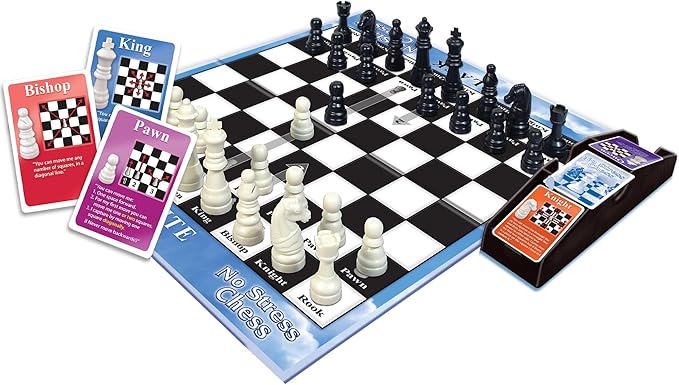
    5. No Stress Chess by Winning Moves Games USA

    The No Stress Chess set by Winning Moves Games USA is the ideal gift for beginner chess players. This set removes the stress from learning how to play chess and remembering all the rules with its unique and helpful queues.

    On one side of the board, you’ll find piece names and arrows indicating how each piece moves. When you’ve mastered these concepts, flip to the other side of the board for a more challenging experience without the guides. A set of cards with visual diagrams showing how each piece moves is also included with the set.

    Get this on Amazon

    4. Talking Chess Acadamy II, AI Voice Coach Chess Set

    The future is here. No need for a chess coach or even an opponent with this AI-powered chess board. The optional chess coach will speak with you as you play, responding to your moves and providing tips as you go.

    With training puzzles, grandmaster games, and an adjustable difficulty level from 800-2200+ Elo-based strength, this set is helping everyone, from beginners to experts, improve at chess.

    Get this on Amazon

    3. Chess Made Simple, Spin Master Games

    The Chess Made Simple set by Spin Master Games features a detailed chess board with helpful labeling. Players will find helpful queues for where pieces go and how they move on the set itself.

    Along with the labeling, the set comes with learning cards featuring the rules, helpful tips, and descriptions of how each piece moves.

    Get this on Amazon

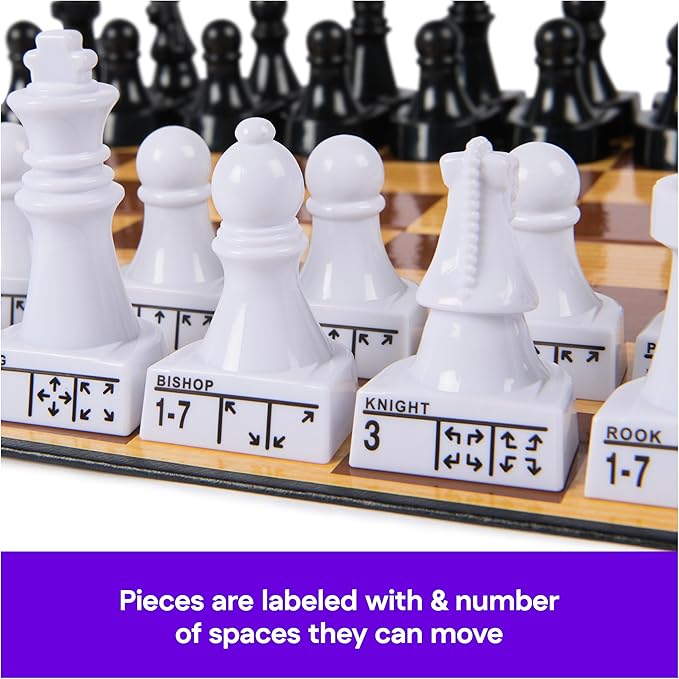
    2. Chess Teacher: A Set for Learners by Spin Master Games

    The Chess Teacher set is specifically designed for beginners and/or regular players who just can’t seem to remember how the knight moves. Each piece features a large label showing which direction it moves and how many spaces.

    Get this on Amazon

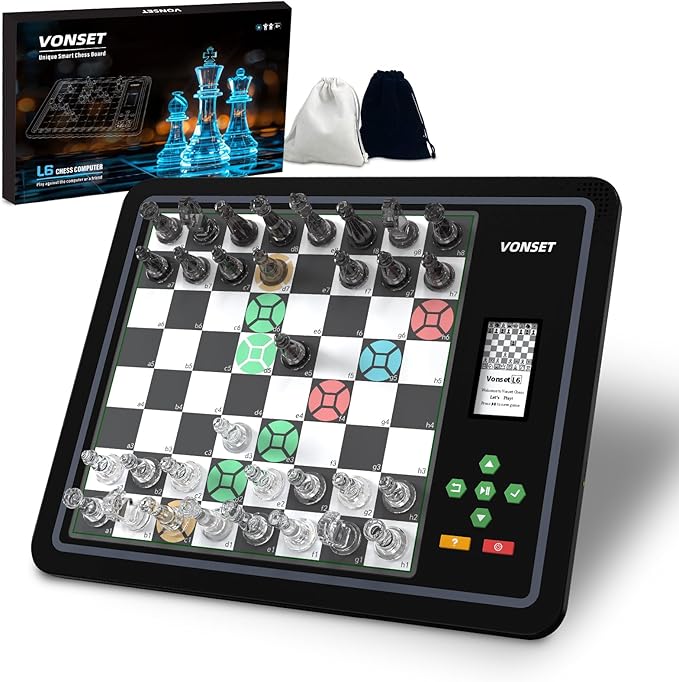
    1. Unique Smart Chess Board by Vonset

    Rounding out the best chess boards for beginners, we have the Unique Smart Chess Board by Vonset. This chess set makes the perfect gift for the dedicated chess beginner in your life. Light up features allow users to play and improve solo against a chess computer.

    The engaging experience of this light-up chess set make it the perfect set for beginners. Not only will they get to learn as they play, with training modes and puzzles available, but they’ll have fun doing it.

    Get this on Amazon

    While it can be difficult to get started, chess is a highly rewarding, fun and cognitively beneficial hobby in the long run. Whether you’re shopping for you or a loved one, these beginner chess boards will set you up for success in your chess endeavors.

    Shop these unique and helpful chess sets today.